Understanding Fuel Price Adjustment (FPA) on Your MEPCO Bill
Many MEPCO consumers see “Fuel Price Adjustment” (FPA) on their electricity bill but are not sure what it means or why it changes from month to month. Sometimes this line alone can add a noticeable amount to the total bill, which creates confusion and worry.
This guide explains, in simple language:
- What FPA is
- Why it appears on your MEPCO bill
- How it generally affects the final amount
- Why it can increase or decrease even when your units are similar
- What you can do if something looks wrong
This page is for general information only. Actual rules, formulas and values for FPA are set by NEPRA and MEPCO and may change. Always rely on official sources for final, up‑to‑date details.
1. What Is Fuel Price Adjustment (FPA)?
Electricity in Pakistan is produced using different fuels, such as:
- Gas
- Oil
- Coal
- Water (hydropower)
- Other energy sources
The cost of these fuels changes over time due to international prices, exchange rates and other factors. When fuel becomes more expensive (or cheaper), the actual cost of generating electricity also changes.
Fuel Price Adjustment (FPA) is a mechanism used to:
Adjust part of your bill according to the difference between previously assumed fuel prices and the actual fuel costs in a later period.
In simple words:
- If fuel prices used in previous calculations were lower than what was actually paid, an extra amount may be added as FPA.
- If they were higher (less common), there could be a reduction or smaller FPA.
FPA is not a separate penalty; it is a cost adjustment linked to fuel used in power generation.
2. Why Is FPA Added to MEPCO Bills?
The main reasons for FPA are:
- Fuel prices are not fixed
International oil, gas and coal prices can rise or fall each month. Electricity generation companies pay these changing costs. - Tariff decisions are made earlier
Base tariffs are often decided using an assumed fuel cost. Later, when actual fuel usage and prices are known, there may be a difference compared to the assumption. - Regulators want to reflect real costs
NEPRA, as the regulator, allows a fuel price adjustment so that the real cost of producing electricity is reflected in consumer bills according to approved rules.
For MEPCO customers, this means:
- FPA is a national‑level adjustment applied according to regulatory decisions.
- MEPCO itself does not independently set this amount; it follows approved notifications and formulas.
3. Where Do You See FPA on Your MEPCO Bill?
The exact layout of bills can change over time, but usually you will find FPA:
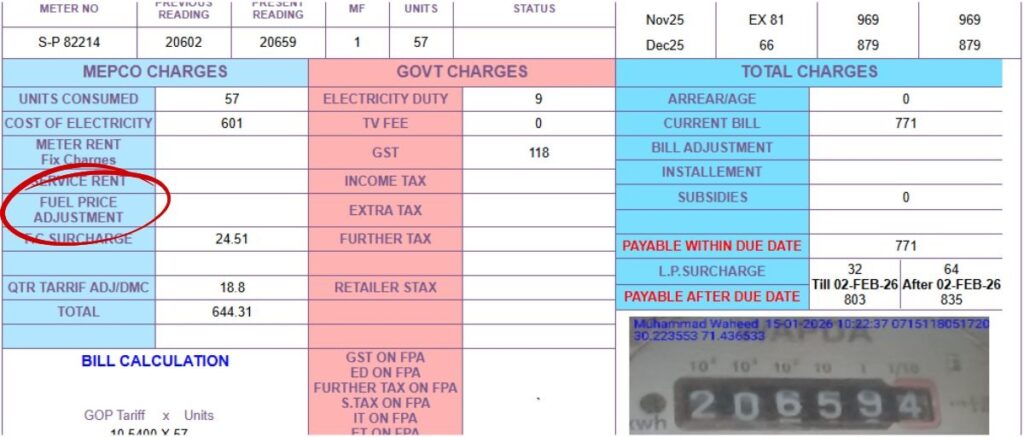
- Listed as a separate line item under the charges section, often called
“Fuel Price Adjustment”, “FPA” or “FCA” (Fuel Charge Adjustment).
This line may show:
- The amount for the current month, sometimes linked to units consumed in a specific earlier period.
- It may be positive (additional charge) or, in some cases, very small or zero if no adjustment is applied.
The total payable amount on your bill includes:
- Energy charges based on your units and slabs
- Fixed charges (if any)
- Fuel price adjustment
- Taxes and other surcharges
- Any arrears or credits from previous bills
4. How FPA Generally Influences the Bill
The detailed formula for FPA can be technical and is officially defined by NEPRA for each period. However, the basic concept is:
- Regulator compares
- The assumed fuel cost that was used when the base tariff was set
- The actual fuel cost recorded for a past period (often a previous month)
- Difference per unit is determined
- If actual fuel cost per unit is higher than assumed → a positive adjustment is approved
- If it is lower → the adjustment may be smaller or, rarely, negative
- Consumers are charged or credited
- This difference is applied to eligible units, according to the regulation and category
- The result shows up as FPA on a later month’s bill
Important points:
- FPA does not replace your normal unit charges; it is additional.
- It is generally linked to your unit consumption, so higher usage can mean a larger FPA amount when a positive adjustment is approved.
The precise details (for example, which month’s units are used, specific rates per kWh) must always be taken from official decisions and circulars.
5. Why Can FPA Change Even If Your Units Are Similar?
You may notice that:
- Your units this month are similar to last month,
- But the FPA line changed significantly.
This can happen due to several reasons:
- Different fuel cost periods
- FPA in a certain month can be linked to fuel costs from an earlier period, not necessarily the month shown at the top of your bill.
- If fuel prices for that earlier period were much higher, FPA in your current bill can increase.
- New regulatory decisions
- NEPRA may approve a new fuel adjustment based on updated information.
- This can change the per‑unit adjustment used in that billing cycle.
- Changes in your eligible units
- Even if your total units are similar, the number of units to which FPA applies can change due to slab rules or other technical factors.
Because of these factors, FPA is sometimes more volatile than the basic energy charge.
6. Is FPA a Fine or Penalty?
No. Fuel Price Adjustment is not a fine for late payment or misuse. It is:
- A cost adjustment to reflect the actual fuel expense in generating electricity.
- Applied according to regulatory procedures.
Fines or penalties are normally separate items like:
- Late payment surcharge, which you see only when you pay after the due date.
- Other specific charges mentioned by name.
FPA will usually appear on the bill regardless of whether you paid your previous bills on time, because it is connected to fuel cost, not your payment behaviour.
7. Can You Reduce or Avoid FPA?
Individual consumers cannot control national fuel prices or regulatory adjustments. However, you can:
- Reduce your overall consumption
- Since FPA is usually tied to units, using fewer units often means a lower FPA amount when a charge is applied.
- Shift usage (for TOU consumers)
- If you have a time‑of‑use meter, managing peak and off‑peak usage can help control total units and cost.
You cannot:
- Ask MEPCO to remove FPA just for your bill if the adjustment has been officially approved for your category.
- Decide to “opt out” of FPA, because it is part of the approved tariff structure.
The only time FPA might be changed for a particular bill is if there is a clear billing error according to MEPCO/NEPRA rules.
8. If FPA on Your Bill Looks Unusual
If you feel the FPA amount seems unusually high:
- Compare with previous bills
- Look at several months to see how the FPA line has changed.
- A one‑time spike may match a particular official fuel adjustment.
- Check official announcements
- NEPRA and official channels sometimes publish fuel adjustment decisions.
- Local news and official websites may also report on these changes.
- Check your unit usage
- If your units have increased (especially into higher slabs), any per‑unit FPA will also multiply.
If, even after these checks, you believe there may be a technical or posting error in your specific bill, you can contact MEPCO through its helpline or local office and ask for clarification, taking your bill and ID with you.
9. What to Do If You Suspect an Error Related to FPA
While FPA itself is set by regulation, mistakes in billing or application can happen in any large system. If you believe an error has occurred:
- Gather documents
- Latest bill showing FPA
- Previous bills for comparison
- Any relevant notices or letters you received
- Use official contact channels
- Call the MEPCO helpline listed on your bill, or
- Visit the local customer service or sub‑division office
Ask them to explain the FPA amount and, if necessary, to check whether it has been correctly applied.
- Register a formal complaint if needed
- If you still believe there is a mistake, request a written complaint registration.
- Keep the complaint number or receipt for follow‑up.
- Follow up on the next bill
- Check whether any correction or explanation appears.
- If nothing changes and you still disagree, you may need to escalate within official MEPCO/NEPRA complaint channels according to their procedures.
Your site can link internally to detailed articles about billing complaints and common errors to guide users through this process.
10. Key Points to Remember
- Fuel Price Adjustment (FPA) is a line on your MEPCO bill that reflects changes in fuel costs used to generate electricity.
- FPA is not a penalty; it is an officially approved cost adjustment, usually tied to your unit consumption.
- The exact formulas, rates and timing of FPA are defined by NEPRA and MEPCO and may vary from month to month.
- Even if your units stay similar, FPA can change due to national fuel price variations and regulatory decisions.
- If an FPA amount seems unusual, first compare bills and check official information, then contact MEPCO through official customer service channels if you still suspect an error.
This guide is designed to help you understand the concept of FPA so that your MEPCO bill is less confusing. For exact numbers, dates and legal details, always refer to official tariff documents, notifications and MEPCO’s own communications.
Simple Example of How FPA Might Affect Your Bill
Because the real FPA formula and rates are decided by NEPRA and MEPCO and can change at any time, we cannot give exact values here. However, a very simple example can help you understand the basic idea.
Imagine that for a previous period, the regulator finds that the actual fuel cost of generating electricity was higher than the cost that was used when setting the base tariff. After calculations, they approve a positive fuel adjustment of, for example, Rs 1.50 per unit for that period. This is only a sample figure, not an official rate.
Now, suppose your household used 300 units in the month for which this adjustment is applied. In this simple example, the FPA portion of your bill for that month might be roughly:
300 units × Rs 1.50 (sample FPA rate) = Rs 450 (sample FPA amount)
This Rs 450 would then appear on your bill as Fuel Price Adjustment for that billing cycle, in addition to your normal energy charges and other items. If your usage was higher, the FPA amount would be higher, and if your usage was lower, the FPA amount would be smaller, assuming the same approved per‑unit adjustment.
Again, this is only a hypothetical example to show the concept. Actual FPA values and calculations are based on official decisions and may be very different from the numbers used here.